A Rainy Film Night, Heard with the Screen Covered
A screen-covered film listening exercise helps you separate dialogue, music, room tone and silence, then compare what sound alone led you to imagine.
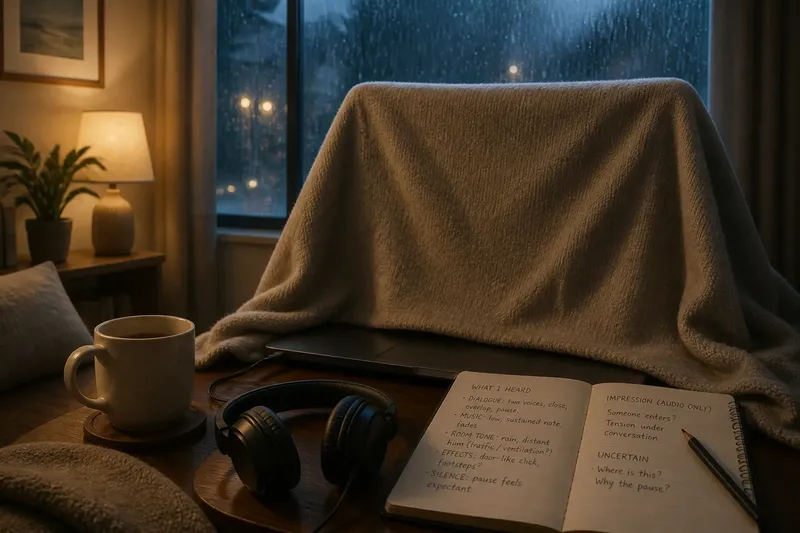
Rain ticks against the window as a familiar film scene begins, but the screen is covered by a folded blanket. A screen-covered film listening exercise can make a well-known moment feel newly uncertain: a voice sounds close, a pause feels loaded, and a low musical note might belong to the room—or to the score.
The point is not to guess the picture correctly. It is to notice how sound steers attention before an image confirms, complicates or overturns that impression. Choose a short scene you know reasonably well, listen once without looking, then watch it again with the sound on. The change between those passes is the subject.
Choose a scene with more than one sound layer
Pick a contained moment rather than a whole episode or film. A conversation interrupted by a door, a character waiting in a kitchen, or a quiet exchange in a car can offer dialogue, music, environmental sound and pauses without asking you to track a complicated plot. Familiarity helps because you are less likely to spend the listening pass trying to work out who everyone is.
Use a television, laptop or streaming app with ordinary playback controls. A pair of headphones can make soft details easier to hear, but speakers are fine if the room is reasonably quiet. Cover the display with a piece of card or turn the screen away; avoid anything that blocks ventilation or makes the device awkward to control. Keep captions off during the listening pass, since written dialogue can pull attention away from vocal tone and timing.
Choose a scene short enough to replay without frustration. If the app makes it easy, note the beginning and end points or use the progress bar to return to the same moment. The comparison works best when the two listens cover the same stretch.
Listen once for what occupies the room
Start playback with the screen hidden. Let the scene run without pausing to identify every sound. Attend first to the broad shape: is the space busy or spare, close or open, calm or unsettled? Then listen again, if useful, for particular layers.
- Dialogue: Notice who speaks, how near the voices seem, and whether they overlap, hesitate, whisper or leave space between phrases.
- Music: Listen for a melody, sustained tones, rhythm or a sudden absence. Ask whether the music seems to lead your feelings or simply sit behind the action.
- Room tone: Attend to the steady background texture: a hum, distant traffic, ventilation, rain or the soft acoustic character of an interior.
- Specific effects: Notice sounds with a clear event attached, such as footsteps, a cup set down, a latch or a passing vehicle.
- Silence: Ask what seems to stop, and whether the pause feels empty, expectant or crowded by faint background sound.
These categories can overlap. A low rumble might be a vehicle, designed sound or music; room tone may have been shaped in post-production. You do not need to assign a source with certainty. Record what you hear and how it affects your reading of the moment.
Keep impressions separate from guesses
After the audio-only pass, write down a few brief observations. Separate audible details from the story you built around them. “A voice becomes quieter after a sharp sound” is an observation; “the speaker is frightened by someone entering” is an interpretation. Both can be useful, but keeping them distinct makes the second pass more revealing.
Say you choose a familiar scene in which two people talk while rain taps somewhere in the background. With the screen covered, you hear one speaker pause after a door-like click and imagine that someone has entered. When you watch the scene, the click may turn out to be a utensil touching a table, while the pause belongs to the conversation. The sound did not fail: it gave you an ambiguous cue, and your mind supplied a plausible picture.
Also note what you cannot tell. A voice may sound strained without revealing why. A room may seem large because of its reverberation, yet the image may show a small tiled space. Uncertainty is part of the listening experience, not a problem to solve before looking.
Watch again and compare the picture with the sound
Replay the same stretch with the screen visible and the sound on. Start with your notes, then look for where the image agrees with your impression, where it redirects you, and where sound carries information the picture does not make prominent.
A close-up may make a quiet breath seem significant; a wider view may reveal that the background hum belongs to a refrigerator. A character’s still face can make a pause look controlled, while the voice you heard alone suggested uncertainty. The image does not simply correct the sound. It changes the meaning of the sound by giving it a visible source, a body and a setting.
Pay attention to attention itself. Did music lead you towards a feeling before the scene showed a reason for it? Did a small sound become noticeable because the dialogue stopped? Did the room tone make an ordinary pause feel continuous rather than empty? These are ways sound shapes how a scene unfolds in the viewer’s mind.
What should you listen for in a second pass?
How can I tell music from room tone?
Listen for whether the sound has a musical shape, such as a repeating pulse or sustained note, and whether it changes with the scene’s emotional movement. Room tone usually suggests a continuing environment, though a film can blur the distinction deliberately.
Should I choose a scene I already know?
Yes, familiarity gives you a useful point of comparison: you can hear what the audio suggests without needing to follow the plot from scratch. A scene you only partly remember can also work, provided it is short and self-contained.
What if I cannot identify a sound?
Describe its qualities instead: low or high, steady or intermittent, close or distant. The exercise concerns how it affects your impression, not whether you can name every source.
Can I do the exercise with animation or online video?
Yes. Animation often makes the relationship between a visible action and its sound especially noticeable, while online video may use music or room tone differently from a dramatic scene. Keep the same listening-first, viewing-second order so the comparison remains clear.
Notice how silence is made
Silence on screen rarely means that every sound has disappeared. A scene may remove music while leaving breath, fabric, distant traffic or electrical hum. That reduced texture can make a small movement feel unusually exposed. In another moment, even those faint sounds may drop away, creating a sharper break in the scene’s soundscape.
On the second pass, distinguish between a pause in speech and a broader withdrawal of sound. Ask what remains audible, what has receded, and whether the image encourages you to read the pause as comfortable, awkward or threatening. The answer may depend on a glance or gesture, but the sound has already shaped the space in which that gesture lands.
Use the comparison to refine your attention
Finish by returning to one detail you missed or misunderstood, rather than trying to produce a verdict about the scene. You might revisit the first entrance of the score, the moment the room tone becomes noticeable, or the small sound that changed your imagined setting. Listen once more with the screen covered if you want to test whether you can now hear that detail without visual prompting.
This screen-covered film listening exercise is most useful when the notes stay modest: what was audible, what you inferred, and what changed once the image appeared. On a rainy evening, the covered screen turns a familiar scene into a small listening space of its own. The film may look the same when you uncover it; your attention to the sounds holding it together need not.