Before Dialogue: How Silent Screens Made Words Visible
Explore how silent-film intertitles, gestures and objects shared the work of storytelling, and learn to read the pauses between written words and images.
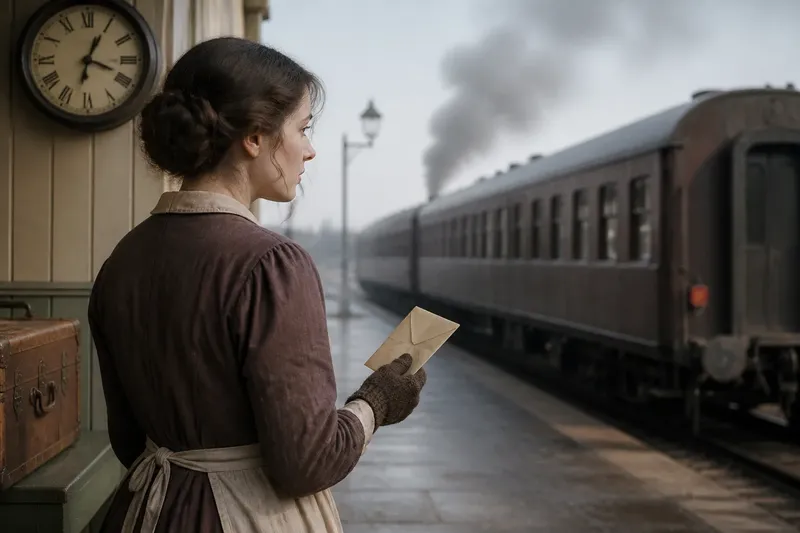
A woman waits on a railway platform, a letter folded in her glove. She watches the train pull away, then studies the paper as if its few lines have altered her plans. Silent-film storytelling made words visible through intertitles, bodily expression and objects that viewers could read. Rather than simply replacing speech, these elements shared the work of telling a story.
A letter gives a scene its first question
Imagine a filmmaker shaping a short silent sequence about Mara, a shop assistant who receives a letter from her brother. He asks her to meet him at the station before he leaves town. The scene needs to convey the request, Mara’s feelings and her decision without recorded dialogue. This invented situation shows how a card, a performance and a setting might work together.
The first image shows Mara sorting parcels behind the counter. A postman leaves an envelope among them. She recognises her brother’s handwriting and pauses before opening it. The audience does not yet know what the letter says, but her careful handling makes it seem important. A close view of the address supplies practical information; her hesitation gives the moment emotional weight.
A title card could then present the message: “Meet me at the station before the last train.” The words explain what a gesture alone might leave unclear. But Mara’s stillness before reading and her grip on the letter afterwards also matter. They give the request a human consequence without spelling out her response.
Intertitles made language part of the image
Intertitles could present a character’s words, explain a change of place or time, identify a speaker, or offer a brief narrative comment. A dialogue card might show what someone says, while an explanatory card could connect events the film does not depict. Viewers were being asked to read as well as watch, and the card’s purpose shaped how its words met the image.
In Mara’s sequence, a card framed as her brother’s message gives the request a source within the story. A separate card announcing that the train leaves that evening would instead provide context. The first conveys intention; the second establishes urgency. Neither needs to explain Mara’s response if the next image makes her action clear.
A card also creates a pause in the flow of moving images. The viewer reads, then returns to Mara and considers her face and hands in light of the words. The image may confirm the card, complicate it or show something it leaves out.
Placement changes the effect. A card before a revelation can invite anticipation; one after a reaction can name a thought that the performance leaves uncertain. Yet spelling out every feeling can reduce the work left to acting and visual context. The craft lies in deciding what the card needs to say and what the image can carry.
Gesture made intention legible
Silent acting did not depend only on large expressions. A performer could make a choice readable through a sequence of distinct actions: Mara opens the letter, reads, looks towards the station clock, then folds the paper and puts it away. Each movement connects the message with a possible decision. If she tears the letter instead, the same words take on a different force.
Hands could interact with objects while drawing attention to them. A hand held over a signature might suggest hesitation; a reach for a coat might signal resolve. These actions had no single fixed translation. Their meaning depended on the surrounding images, the character’s established behaviour and the order in which events appeared.
In the invented scene, the filmmaker might omit any card saying that Mara is torn between her job and meeting her brother. She looks at the letter, then at the locked cashbox and the coat by the door. The glance between them lets viewers infer a conflict from what she notices and eventually touches. It is the context, rather than a universal gesture, that makes the choice intelligible.
A greeting, formal bow or guarded exchange might suggest a relationship or social role, but viewers still needed context to read it. Specific actions tied to the scene could do more than an exaggerated expression asked to carry every feeling on its own.
Objects and settings complete the thought
The letter tells Mara what her brother wants; the station clock gives the request urgency; the counter and coat make her obligations visible. Each contributes a different part of the scene’s logic. Without the clock, the deadline might be less clear. Without the coat, her departure would have no visible preparation.
Suppose, within this invented sequence, Mara takes the coat but leaves the shop key on the counter. Viewers can see that she is choosing to go without a card announcing the decision. A later shot of her entering the station confirms it through action. The scene moves from request to consideration to consequence, with written language supplying information at the point where it is most useful.
An object can also complicate a card. If Mara reads a cheerful message but turns away from a photograph tucked into the envelope, the image hints at a history the words do not mention. What a card seems to mean depends partly on what viewers have just seen and what remains in the frame afterwards.
Timing shifts the balance between reading and watching
The timing of an intertitle’s appearance and disappearance could change how a scene felt. A brief card might carry a simple line before the action resumed; a denser passage could require a more deliberate pause. Without a particular film or screening to hand, it is safer not to assign one standard rhythm to silent cinema. The useful point is that every interruption shaped the viewer’s movement between reading and watching.
In Mara’s case, showing the message before her reaction gives the audience the information before interpreting her response. Showing her open the letter and hesitate before revealing its words would produce a different sequence: uncertainty, a reading pause, then a reaction. The same material can feel different when its parts change order.
For a present-day viewer, notice what the card provides: speech, a location, a time or a cue to a detail. Then watch the image that follows. Does it confirm the words, reveal a feeling they omit or challenge their apparent meaning? This approach draws attention to the exchange between text and performance, rather than treating a card as a simple replacement for audible dialogue.
How do intertitles and silent performances work together?
Were intertitles used only for dialogue?
No. They could present conversation, provide narrative information, mark a transition or clarify a name or place. Their function depended on the scene, and a film could use different kinds of card for different purposes.
Could viewers follow a scene after missing a card?
Images and actions might still establish the broad situation, though a card could contain a detail that changed how those images were understood. Missing it might leave a finer point uncertain rather than make every action unreadable.
Did silent actors rely on exaggerated gestures?
Some performances used broad movement, while precise handling of objects, posture and facial expression could also carry meaning. The surrounding action helped viewers interpret those choices.
Why does an intertitle change a scene’s rhythm?
An intertitle separates written language from moving images, asking viewers to shift attention between reading and watching. The pause can give a reaction room to register, and the returning image invites viewers to connect the words with what a character does next.
An unfinished gesture can carry the last word
Return to the invented scene. Mara reaches the station as her brother boards the train, but the film need not add a card explaining her feelings. She offers him the folded letter. He looks at it, then back at her. Whether they reconcile can remain unresolved; the action has already conveyed that she chose to come and that he understands the choice.
To read silent-film storytelling, look for the division of labour among words, gestures and settings. An intertitle may make a request precise; a hand on a letter may show its effect; a clock or a coat may make the next choice visible. The small pause between a card and the image that follows is often where viewers work out what the words alone cannot say.